Case study / Clearpath
Turn lead operations into a system that can fail clearly and recover cleanly.
A containerized AWS lead-intelligence API translated from operating workflows, validated during a short-lived AWS deployment, and then deliberately torn down.
- Role
- Independent builder
- System
- Clearpath
Demo boundary
Validated, then torn down
No live demo
Short-lived AWS validation was followed by teardown. No live demo is maintained, and the recorded evidence is point-in-time validation.
01 / Frame
Problem
- Lead intake, source research, scoring, and follow-up become fragile when workflow rules live across spreadsheets and one-off handoffs.
- A replacement needs durable API contracts, observable container behavior, and a documented exit path for cost control.
Constraints
- Validation had to prove the AWS path without turning a portfolio workload into an indefinite hosting commitment.
- GHL-compatible intake describes a payload shape, not a verified third-party integration.
- Cost figures are estimates, not billing records.
02 / System
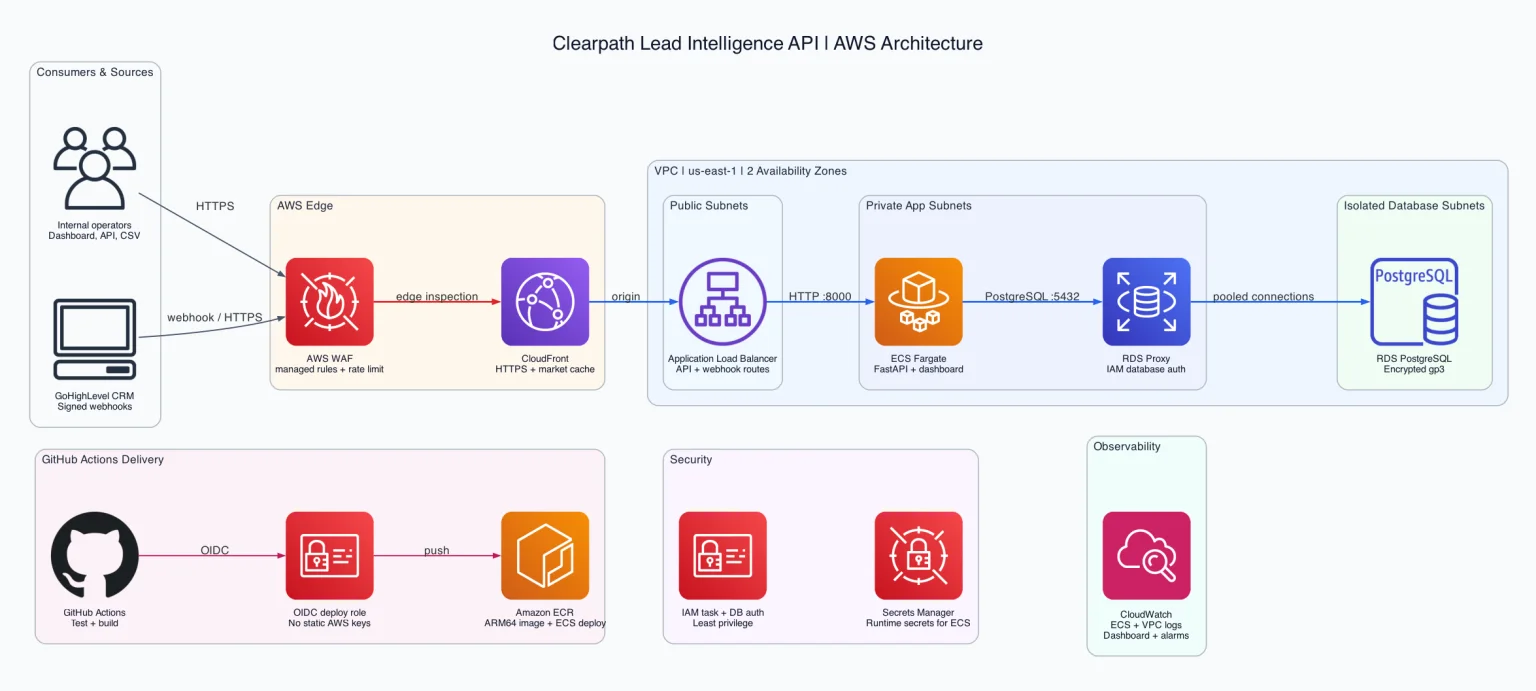
Real architecture, retained as review evidence.
03 / Decisions
Three decisions and the cost of each.
01
Model the operating workflow as an API contract
Explicit intake, scoring, and reporting boundaries make the workflow testable and easier to hand off.
Tradeoff
Real provider integrations still need account-specific authentication and acceptance testing.
02
Validate the container path on AWS
A short-lived deployment exercised the edge, load balancer, Fargate, data, secret, and alarm boundaries together.
Tradeoff
Healthy tasks during that window are point-in-time evidence, not an uptime record.
03
Make teardown part of completion
A documented destroy path treats cost recovery and resource inventory as operating responsibilities.
Tradeoff
There is no live-demo CTA after teardown; reviewers use the retained artifacts instead.
04 / Evidence
What the record supports—and how far it goes.
93
validated resources later destroyed
Inventory and teardown evidence; not a long-term availability claim.
Inspect evidence36
API tests
Recorded application test result for the validated revision.
Inspect evidence339
Checkov passes
0 failed, 44 skipped; static analysis evidence for the recorded revision.
Inspect evidence2
healthy tasks during validation
Point-in-time deployment evidence, not a continuing availability statement.
Inspect evidence
05 / Reliability & security
Point-in-time health qualified by tests and teardown records.
API and infrastructure checks support the validated revision. Healthy tasks from the short-lived run remain deployment evidence, not a continuing availability statement.
API and infrastructure test resultsEarly task failures became a corrected startup path.
Initial ECS tasks failed health checks during early revisions. After the image and startup path were corrected, the service stabilized at two healthy tasks for validation; the record preserves that sequence without turning it into a long-term availability claim.
Live-validation summary06 / Limits
Known limits
- Two healthy tasks were observed during validation; they do not establish long-term availability.
- GHL-compatible intake is not a verified GHL integration.
- The cost model is an estimate, not billing evidence.
- The AWS environment was torn down after validation, so there is no live-demo CTA.
Path to sustained operation
- Run provider-specific acceptance tests with real credentials held in a controlled secret boundary.
- Add scheduled restore exercises and retain recovery-time evidence with the runbook.
- Reconcile estimates against billing data and define scaling alarms before sustained operation.
07 / Artifact index
Follow the work into the repository.
- architectureAWS container architecture
- iacTerraform infrastructure
- ciTerraform validation CI
- runtimeLive-validation summary
- testsAPI and infrastructure test results
- runbookOperator runbook
- limitationsTeardown record
- limitationsCost estimate